
Sintered silicon nitride (Si3N4) and sialon ceramics often possess colour variations which can occur within the same batch, as a gradient through a cross section, or amongst parts sintered in the same sintering cycle.
Although colour variations do not necessarily affect the mechanical properties, the materials visual impression is still important for both material selection and customer satisfaction, therefore influencing the commercialisation of the product.

Figure 1 shows an example of some cold iso-pressed (CIP) Syalon 101 rods (β-sialon) with the same composition, but which display variations in colour.
This article will aim to discuss the reasoning behind colour variations and the effects as a result.
Colour Variations Explored
Visual differences in Si3N4 based ceramics, such as sialon (Si-Al-O-N), with the same composition are typically cosmetic and do not necessarily indicate changes in mechanical performance. Slight compositional variations, however, can drastically affect the thermodynamic stability of phases, thus influencing the final mechanical properties as well as visual appearance of the material.
The primary variables which can affect colour variations seen within Si3N4 based ceramics are:
- Phases present (either crystalline or amorphous)
- Sintering atmosphere
- Impurity content
- Crystallisation of secondary phase
- Porosity
(M. Herrmann, 2001).
Phases Present
Different phases, i.e. different crystal structures of the same compound, may arrange themselves differently depending on processing conditions, compositional variations or impurities. A simple analogy is the comparison between graphite and diamond. Their compositions are the same, but they are structurally different, as seen in Figure 2:
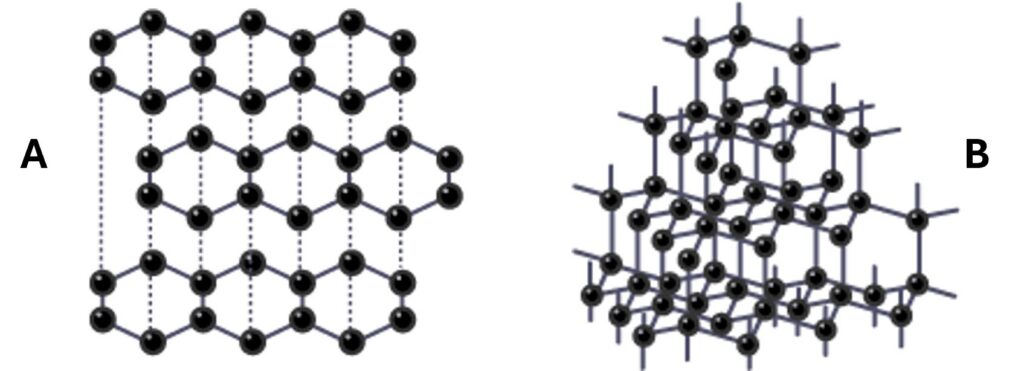
- Graphite – arranged in flat sheets, resulting in a grey appearance.
- Diamond – arranged in a rigid 3D network, making it transparent.
The same can be said about α- and β-sialon phases; They are both Si3N4, having almost identical chemistries, but have different packing structures which results in individual appearances. Syalon 050, which is an α/β-sialon composite sometimes displays an indicative webbed pattern caused by a duplexed microstructure. By eye, 050 looks inhomogeneous which may be alarming to customers. However, the α/β-sialon composite offers outstanding hardness, maintains a high fracture toughness, and allows applications in temperatures of up to 1450°C before oxidation.
Sintering Atmosphere
Si3N4 based ceramics are most commonly sintered under a nitrogen-rich atmosphere to prevent dissociation of nitrogen from silicon at high temperatures, following the reaction below (P. Popper, 1983):

More dissociation results in a higher mass loss and darker colouration, due to both the volatilisation of N2 gas and the formation of solid Si inclusions. Goeb et al denoted that a higher silicon content resulted in a darker coloured material (O. Goeb, 1997). Inhomogeneous reduction of Si can thus cause a ‘clouding’ pattern on the surface of Si3N4 materials.
Precision atmospheric control on sintering through real time gas pressure monitoring systems allows International Syalons to thermodynamically supress the dissociation of Si3N4 to ensure minimal inhomogeneity across materials. However, localised gas pressure differentials can develop within regions close together, which thus may result in minor colour variations between parts or across the same part. However, this should not cause concern as following the appropriate testing methods, mechanical properties can be validated, verifying negligible differences in mechanical performance.
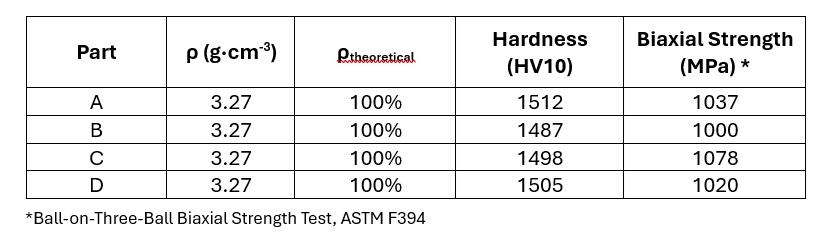
Figure 3 shows four batches of Syalon 101 (β-sialon), displaying variations in colour not only between each other, but within the same part. The measured mechanical properties show no significant differences, and follow no trend based on colour, noted in Table 1.

Impurity Content
It is well documented that impurities within materials can drastically affect the resulting appearance of the material. For example, clay bricks are fired in air (oxygen rich), and when iron impurities within the clay react with oxygen at high temperatures, forming iron oxide, the finished brick becomes a reddish-brown colour (V. Valanciene, 2010).
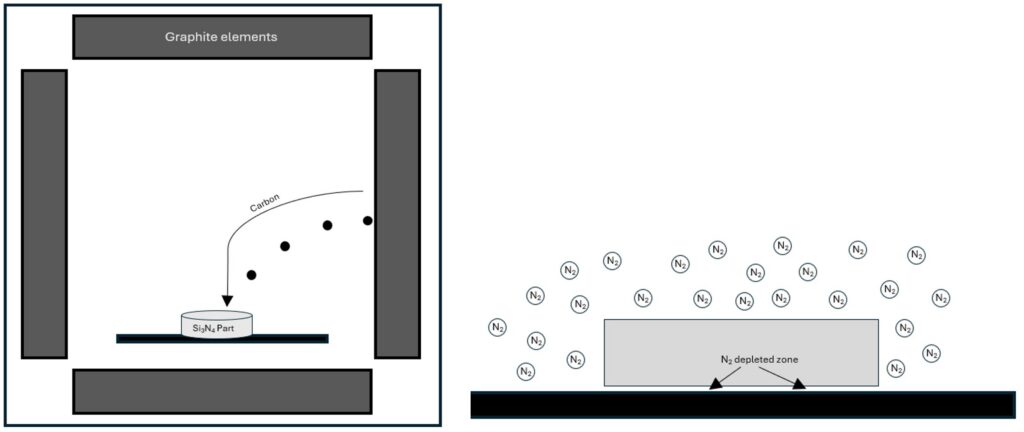
Contact or proximity to sintering furniture can result in localised discolouration or spotting on the surface of parts, usually happening through chemical migration or vapour-phase reactions. For example, carbon could migrate through the sintering atmosphere from graphite elements, resulting in dark spots on parts. Or localised nitrogen depletion, which may happen on the flat base of parts can be shielded from N2 gas, leading to localised decomposition as discussed earlier. A schematic can be seen below in Figure 4:
Impurity levels as low as 0.1% can affect the colour of sintered materials. Early research on Si3N4/sialon ceramics in the 1970s utilised compositions with iron impurity levels >0.1%, leading to a black colour on sintering. Technical developments in manufacturing and processing has led to a consistent production of high-quality sialon systems in more recent years, however the presence of foreign inclusions are still common when low purity raw materials are used, or when the rigor of the manufacturing environment is compromised.
Some areas which pose contamination risks are:
- Milling media
- Mill lining abrasion
- Tooling wear
- Sintering crucible reactions
- Heating element volatilisation
International Syalons maintains industry-leading purity standards through advanced processing with a high degree of consistency and repeatability. By utilising our own Syalon milling media and sintering systems, contamination and foreign inclusions common in lower-tier manufacturing are prevented. Furthermore, multi-stage quality control ensures that materials meet standards, consistency and performance.
Crystallisation of Secondary Phases
The structure of secondary phases also play a role in the colour variation noted in sialon ceramics. Si3N4 is commonly sintered with the addition of sintering aids such as Y2O3, MgO or other rare-earth oxides in the form of RexOx. These melt on heating to to form a low viscosity liquid phase which both reduces the sintering temperature and increases densification through enhanced diffusion, known as liquid phase sintering (LPS) (R. German, 2009).
However, these additives (apart from Al2O3), cannot be substituted into the Si3N4 lattice. On cooling, they form either crystalline or amorphous secondary phases, depending on composition and thermal processing. The precipitation of this secondary phase can affect the visual appearance of the sintered material via light scattering and mismatches in refractive index, compared to Si3N4 grains.
Moreover, it is well established that secondary phases contribute to mechanical performance not only through their direct effects, but also by influencing the grain morphology of the primary phase (Y. Liu, 2003; H. Kleebe, 2004). Nevertheless, the microstructure can be tailored through optimised processing conditions. International Syalons has developed a refined processing route for all grades, ensuring consistency, quality, and reproducibility across production materials.
Porosity
Porosity within a part means there are more pockets which arent occupied by sintered material. Since the refractive index (RI) of air, i.e. pores, ≈ 1, and the RI of sialon is typically > 2, light will scatter and reflect in more directions when it reaches porosity compared to sintered sialon, leading to a lower penetration depth (M. Herrmann, 2001). The light reaches the viewers eye faster before it can be absorbed by the material, leading to a visually lighter material when compared to fully dense sialon. Even porosity levels of >0.2% can make a sintered sialon lighter coloured.
Summary
In conclusion, colour variation in Si₃N₄ and sialon ceramics is governed by processing-related factors including: phase composition, sintering atmosphere, impurity levels, secondary phase behaviour, and porosity. These variations are typically cosmetic and do not necessarily indicate changes in mechanical performance. Through tightly controlled processing and diligent quality assurance, consistent and high-performance materials can be achieved despite minor visual differences.
References
BBC Structures and properties: Allotropes of carbon. Retrieved from https://www.bbc.co.uk/bitesize/ guides/zjfkw6f/revision/4
German, R. M., Suri, P., & Park, S. J. (2009). Liquid phase sintering. Journal of Materials Science, 44(1), 1–39.
Herrmann, M., & Goeb, O. (2001). Colour of gas-pressure-sintered silicon nitride ceramics part I. experimental data. Journal of the European Ceramic Society, 21(3), 303–314. doi:10.1016/S0955-2219(00)00205-3
Kleebe, H., Pezzotti, G., & Ziegler, G. (1999). Microstructure and fracture toughness of Si3N4 ceramics: Combined roles of grain morphology and secondary phase chemistry. Journal of the American Ceramic Society, 82(7), 1857–1867.
Liu, Y., Jianbao, L., Yongjun, C., & Jinhui, D. (2003). Secondary crystalline phases and mechanical properties of heat-treated Si3N4. Materials Science and Engineering: A, 363(1), 93–98. doi:10.1016/S0921-5093(03)00622-1
Obenaus, P., Herrmann, M., Siegel, S., & Goeb, O. (1997). Origins and avoidance of colour inhomogeneities in silicon nitride ceramics. Key Engineering Materials, 132-136(2), 751–754. doi:10.4028/www.scientific.net/KEM.132-136.751
Popper, P. (1983). Sintering of silicon nitride, a review. Progress in nitrogen ceramics (pp. 187–210). Dordrecht: Springer Netherlands. doi:10.1007/978-94-009-6851-6_15 Retrieved from http://link.springer.com/10.1007/978-94-009-6851-6_15
Valanciene, V., Siauciunas, R., & Baltusnikaite, J. (2010). The influence of mineralogical composition on the colour of clay body. Journal of the European Ceramic Society, 30(7), 1609–1617. doi:10.1016/j.jeurceramsoc.2010.01.017