Heat, pressure, and cyclic loading produce an unforgiving environment for welding pins and tooling components. With every production cycle, thermal gradients and mechanical forces place stress on the material, encouraging microscopic fissures to form and extend into larger cracks. The outcome often results in premature component failure and, therefore, production interruptions and rising operating costs. Advanced sialon ceramics are specifically engineered to resist these failure mechanisms, helping manufacturers achieve longer service life and greater process reliability.
The Root Causes of Fissures and Cracks in Heavy Tooling
Thermal shock is a leading cause of fissures and cracks across welding and metal-forming processes. Welding pins often experience intense heating followed by rapid cooling, forming internal tensile stresses that can initiate microscopic damage.
Repeated impact and cyclic loading generate another failure mechanism. Robotic welding systems and high-volume production lines subject tooling to continuous mechanical stress. Over time, fatigue can transform minor surface defects into larger fissures and cracks.
Material quality also influences performance. Traditional oxide ceramics and lower-grade tooling alloys may contain microscopic pores or voids. Such defects act as stress concentrators, providing an easy route for crack propagation and increasing the likelihood of premature failure.
The Science of Resistance: Microstructural Engineering
Traditional oxide ceramics like alumina often struggle in severe welding environments. With a fracture toughness typically around 3-4 MPa m^0.5 and thermal shock resistance often limited to approximately 200°C, they can be vulnerable to crack initiation under rapid thermal cycling and repeated mechanical loading. Advanced sialon ceramics use elongated beta-sialon grains to interrupt crack growth. Instead of travelling in a straight line, fissures and cracks are deflected through the microstructure, reducing their ability to propagate. Advanced sintering techniques also produce a dense matrix exceeding 99% theoretical density. By eliminating internal porosity, advanced sialon ceramics remove common initiation points for cracks and improve long-term reliability.
How Advanced Ceramics Prevent Welding Tooling Failure
Preventing fissures and cracks necessitates addressing the specific conditions that generate them. Advanced sialon ceramics reduce several of the most common failure mechanisms found in welding tooling, helping components maintain structural integrity throughout extended production cycles.
Limiting Surface Damage from Weld Spatter
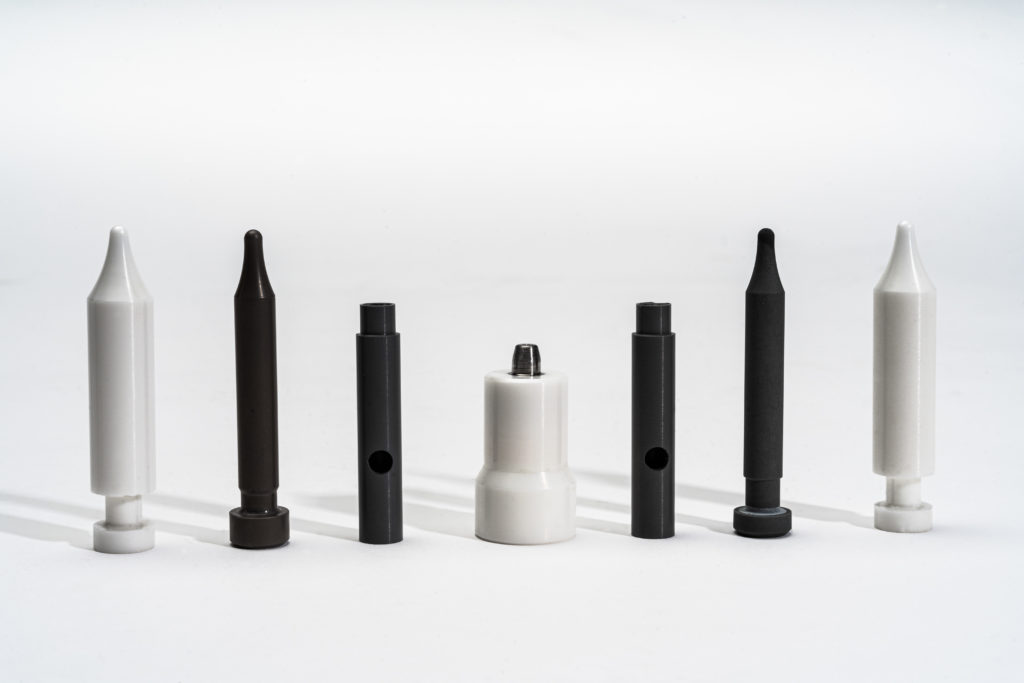
Molten weld spatter can adhere to tooling surfaces, forming localised hot spots and surface damage during removal. As thermal cycling continues, those damaged areas become initiation points for fissures and cracks, particularly in high-use tooling components such as welding pins, welding rolls, and locating pins. Sialon ceramics exhibit non-wetting behaviour, preventing molten metal from bonding to component surfaces and reducing conditions that encourage crack formation.
Eliminating Arc-Induced Thermal Fracturing
Stray electrical current can generate arc strikes that cause local melting and severe thermal shock. Even small arc events may produce microscopic defects that grow under repeated operating loads. Because sialon ceramics act as electrical insulators, they prevent current flow and therefore eliminate arc-induced thermal damage, a common cause of fissures and cracks in welding pins and resistance welding fixtures.
Reducing Stress Concentrations During Service
Repeated clamping, positioning, and impact loads introduce stress concentrations that can initiate cracking. Sharp load transitions are extremely problematic in high-volume automated welding systems where tooling experiences thousands of cycles each day. The fracture toughness of advanced sialons allows engineers to use optimised geometries that distribute forces more evenly across the component, minimising localised stress accumulation.
Controlling Thermal Expansion Stresses
Conventional metallic tooling materials expand and contract during heating and cooling cycles, forming internal stresses that contribute to thermal fatigue. When these stresses accumulate, small defects can develop into larger fissures and cracks that compromise tooling performance. Sialon ceramics exhibit low thermal expansion and excellent thermal shock resistance, helping prevent crack formation throughout repeated temperature cycling and extending component service life.
Sialon Solutions From International Syalons
International Syalons offers specialised sialon ceramic grades designed to address specific causes of fissures and cracks.
Syalon 101
Syalon 101 combines a fracture toughness of 7.7 MPa m^0.5 with thermal shock resistance capable of handling temperature differentials up to 900°C. This material can be used in location welding pins, welding rolls, and resistance welding fixtures operating in cyclic thermal environments up to 1200°C. Its non-wetting behaviour and resistance to thermal shattering maintain its performance where conventional materials frequently fail, including in applications involving weld spatter exposure and repeated heating and cooling cycles.
Syalon 050
Syalon 050 delivers high hardness alongside a fracture toughness of 6.2 MPa m^0.5, as well as thermal shock resistance up to 600°C. Extrusion dies, forming tools, and wear-resistant components benefit from its ability to maintain dimensional stability at temperatures reaching 1450°C while resisting impact-related damage and crack formation.
Engineering Out Fissures and Cracks
Fissures and cracks are not an unavoidable cost of industrial manufacturing. They are often the result of material properties that do not match operating conditions. International Syalons addresses such a challenge through Syalon 101 and Syalon 050, advanced ceramic grades that deliver fracture toughness, thermal shock resistance, electrical insulation, and long-term reliability. Contact International Syalons now to evaluate your tooling requirements and discover how tailored sialon products can reduce downtime, extend component life, and improve production performance.