Technical ceramics routinely withstand temperatures, corrosive media, and abrasive conditions that would quickly compromise metallic components in demanding industrial sectors such as aluminium casting, glass manufacturing, chemical processing, and power generation. Their reliability, however, depends heavily on how stress develops within the material during service. Because ceramics lack the ductility of metals, they cannot absorb overloads through deformation. Repeated thermal cycling, uneven load distribution, or rapid temperature changes can gradually generate internal stresses that initiate ceramic cracking, often resulting in sudden and costly component failure. Preventing ceramic cracking necessitates careful control of component geometry, operating conditions, and material selection throughout the entire service life of the ceramic system.
Identifying the Root Causes of Ceramic Cracking
Certain stresses develop under industrial service conditions that can initiate ceramic cracking and compromise long-term reliability.
Thermal shock is a common cause of ceramic cracking in aluminium casting, as rapid temperature variation generates damaging internal stress within ceramic components. A ceramic riser tube exposed to molten metal over 700°C and then cooled too quickly will develop uneven temperature profiles. The outer surface responds faster than the core, forming surface tensile stresses during cooling that can lead to sudden fracture during operation or shutdown.
Mechanical loading introduces another common source of ceramic cracking. For kiln furniture used for sintering, uneven support across the base can concentrate weight at a single point. Over time, this localised stress initiates cracks despite the overall load appearing acceptable, increasing the risk of dimensional instability, product defects, and premature failure of kiln infrastructure.
Material response to stress also plays a role in ceramic cracking. Ceramics are strong in compression but weak in tension. In chemical processing pumps, ceramic shafts may experience slight bending while rotating. That small deflection is enough to generate tensile stress on one side, allowing cracks to form and propagate under repeated cycles.
Engineering Design Strategies to Prevent Ceramic Cracking
Design decisions have a direct influence on whether ceramic cracking occurs in service.
Geometry is extremely effective for controlling stress. Ceramic components used in molten metal handling often fail at sharp internal corners where stress concentrates, making these areas common initiation points for ceramic cracking. Replacing abrupt geometric transitions with smooth radii allows stresses to distribute more evenly and reduces the risk of ceramic cracking.
Engineers can improve resistance to ceramic cracking by focusing on:
- Smooth transitions between sections
- Avoiding abrupt geometric changes
- Designs that prioritise even stress distribution.
Wall thickness must also be consistent to avoid ceramic cracking under thermal cycling. Within furnace components such as thermocouple protection tubes, uneven thickness causes differential expansion under heating. This generates internal stress over repeated cycles and increases the likelihood of cracking. Uniform cross-sections ensure predictable thermal behaviour in industrial heating environments and reduce the likelihood of stress-related failure.
Additionally, attention must be given to the interfaces between ceramics and metals, as differences in thermal expansion can form significant internal stress. In casting systems, steel housing expands more than ceramic inserts when exposed to heat. Without a compliant layer to absorb this movement, the resulting mismatch can trigger ceramic cracking. Incorporating graphite gaskets or fibre interlayers establishes controlled movement between metals and ceramics, reducing the likelihood or fracture.
Operational Safeguards Against Ceramic Cracking
Operational control is vital for minimising ceramic cracking in industrial environments.
Among the most important operational safeguards is thermal ramping, particularly in furnace and glass manufacturing processes where temperature instability places ceramic components under significant stress. Rapid heating forms steep thermal gradients within the material, whereas controlled ramp rates promote more uniform heat distribution throughout the ceramic structure. Careful cooling practices, like staged cooling cycles and controlled furnace cooldown rates, are equally necessary, limiting residual stress accumulation as equipment returns to lower operating temperatures.
Effective thermal management typically includes:
- Gradual heating and cooling cycles
- Monitoring temperature uniformity
- Avoiding sudden exposure to extreme heat.
Moreover, vibration can accelerate ceramic cracking in industrial systems exposed to continuous mechanical movement. Take power generation equipment, for example. Here, vibration from pumps and motors introduces cyclic stress into ceramic linings, gradually weakening the material and encouraging crack propagation under repeated loading. Isolation mounts and damping systems can help absorb this mechanical energy, improving structural stability and extending operational lifespan.
Pre-service inspection provides an extra safeguard against ceramic cracking. For high-value applications like semiconductor manufacturing, small surface defects can act as crack initiation points. Non-destructive testing techniques, such as ultrasonic inspection, allow surface and internal flows to be identified before installation, reducing the risk of premature failure.

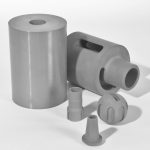
High temperature and wear resistant Syalon 101 components. Image Credit: International Syalons (Newcastle) Ltd.
Material Selection: Countering Crack Propagation
Material selection determines how resistant a component is to ceramic cracking after stress is applied.
Traditional oxide ceramics, like mullite, offer good hardness and corrosion resistance but can struggle in environments involving rapid thermal cycling or mechanical impact. Their relatively low fracture toughness limits their ability to resist ceramic cracking once damage begins. Fracture toughness, measured as K1C, defines resistance to crack growth. Materials with higher values are better equipped to withstand defects and reduce the risk of ceramic cracking under load.
Advanced nitride-based ceramics address the limited crack resistance of traditional oxide ceramics through carefully engineered microstructures. These microstructures help deflect advancing cracks and absorb mechanical energy, decreasing the rate of crack propagation under stress. Consequently, nitride-based ceramics are useful in molten metal handling applications, since severe thermal shock, mechanical loading, and repeated temperature cycling place ceramic components under constant operational strain.
Solving Ceramic Cracking with International Syalons
International Syalons supplies Sialon ceramics that minimise ceramic cracking in industries exposed to severe thermal cycling, mechanical loading, and corrosive operating conditions. Products including Syalon 101 and Syalon 050 are used across demanding industrial applications requiring high fracture toughness and strong thermal shock resistance. Backed by extensive technical expertise in advanced ceramics, International Syalons works with manufacturers to improve component reliability, reduce operational disruption, and identify the most effective material solution for long-term performance. Speak with our experts now for additional information about our available ceramics.