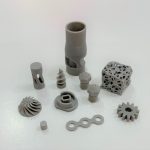
Rapid heating and cooling can place substantial stress on technical ceramics long before their maximum service temperature is reached. Uneven heat distribution produces thermal gradients, causing regions of a component to expand or contract at differing rates. For engineering materials such as alumina and zirconia, the resulting oxide-ceramic stresses can increase susceptibility to thermal shock. Silicon nitride and Sialon respond differently, making their thermomechanical properties a crucial comparison for ceramic components exposed to repeated thermal cycling and intensive high-temperature industrial service.
Thermal and Mechanical Dynamics in Oxide Ceramics
Oxide ceramics are well-established engineering materials, combining hardness, chemical stability, and resistance to abrasive wear to provide durable performance. Alumina (Al₂O₃) is widely selected for electrical insulators, pump components, valve seats, and wear-resistant linings. Zirconia (ZrO₂) offers comparatively high room-temperature fracture toughness, establishing its use in precision components exposed to substantial mechanical loads. Such properties give engineering oxides an important role across industrial equipment where durability is the principal concern.
Despite their strong performance in abrasive and chemically aggressive environments, oxide ceramics can become more susceptible to internal stress as thermal conditions fluctuate. Rapid or uneven temperature changes cause distinct regions of a component to expand or contract by unequal amounts, generating oxide-ceramic stresses within the material. Alumina and zirconia generally have higher coefficients of thermal expansion (CTE) than silicon nitride-based ceramics. During rapid heating, for example, the hotter outer region expands sooner than the cooler interior. Rapid cooling reverses the temperature distribution. In either thermal cycle, uneven expansion or contraction can place regions of the ceramic under tension, where brittle materials are extremely vulnerable to cracking.
Heat transfer also influences the severity of oxide-ceramic stresses. Relatively low thermal conductivity allows temperature differences to persist through a component, producing thermal gradients between hotter and cooler regions. Component thickness, geometry, heating rate, cooling rate, and mechanical constraint can intensify those gradients. Consequently, oxide ceramics perform strongly in steady-temperature service and chemically aggressive or abrasive environments, but repeated furnace cycling, rapid quenching, or abrupt contact with molten material calls for thorough thermomechanical assessment.
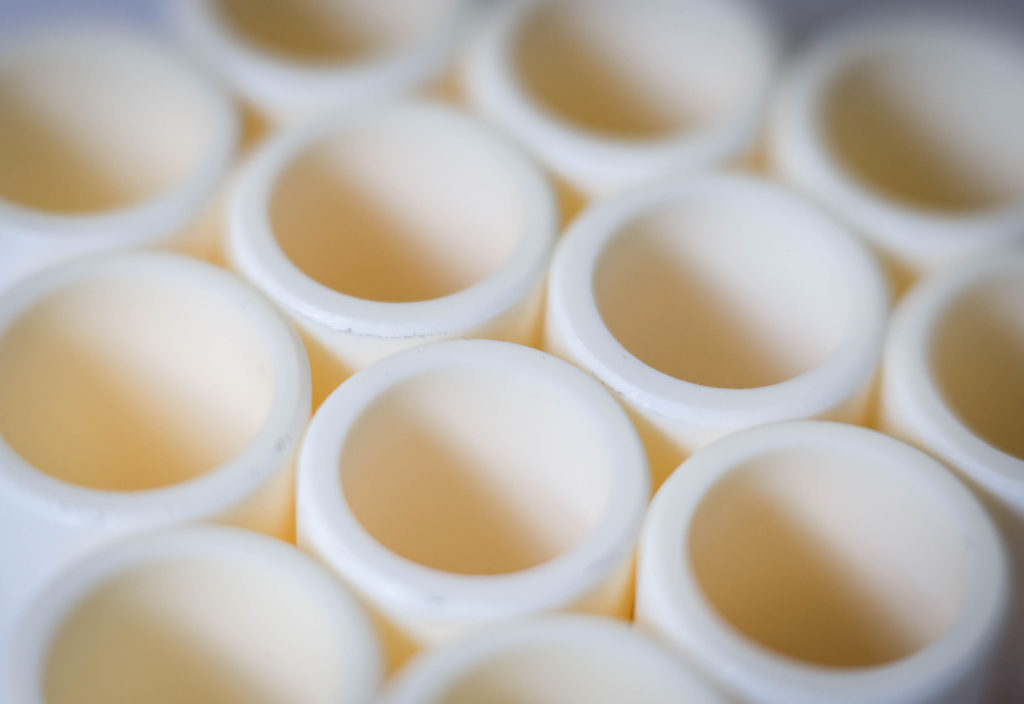
Non-Oxide Ceramics for Extreme Thermomechanical Stress
Non-oxide ceramics provide a contrasting response to demanding thermal conditions. Silicon nitride (Si₃N₄) and Sialon, a family of silicon-aluminium-oxynitride ceramics, possess bonding and microstructural characteristics that give them a favourable combination of thermal and mechanical properties. Comparing these characteristics with the mechanisms behind oxide-ceramic stresses explains why material family can have a major influence on component reliability under severe temperature fluctuations.
Low thermal expansion helps silicon nitride and Sialon resist the stresses produced through rapid temperature changes. Silicon nitride and Sialon undergo relatively small dimensional alterations as temperatures rise or fall, limiting the internal strain generated during rapid thermal transitions. Their thermal conductivity can also distribute heat effectively through a component, reducing localised temperature differences. Smaller dimensional changes and less severe thermal gradients reduce the driving forces behind thermally induced cracking.
Several properties contribute to the performance of silicon nitride and Sialon under severe service conditions:
- Low thermal expansion limits dimensional change during heating and cooling
- Favourable thermal conductivity disperses heat and reduces localised hot spots
- Excellent thermal shock resistance supports repeated heating and quenching cycles
- High hot strength preserves mechanical performance at elevated temperatures
- Strong creep resistance limits time-dependent deformation under sustained high-temperature loading.
Ultimately, thermal shock resistance reflects the interaction of several material characteristics, not just one isolated measurement. A ceramic component may experience a sharp surface temperature change, internal thermal gradients, mechanical restraint, and external loading during the same operating cycle.
Silicon nitride and Sialon offer a combination of properties that ensure they can withstand rapid temperature changes, steep thermal gradients, and simultaneous mechanical loading more effectively than many oxide ceramics. Molten-metal thermocouple protection sheaths, aluminium casting components, burner nozzles, and high-temperature industrial hardware can thus benefit from their thermomechanical performance.

Environmental Stability and Oxidation Resistance
Operating in oxygen-rich atmospheres raises an additional consideration because silicon nitride and Sialon are non-oxide materials. At elevated temperatures, their silicon-containing surfaces react with oxygen and develop a thin, silica-rich layer based principally on silicon dioxide (SiO₂). Far from leaving the underlying ceramic continuously exposed, this surface reaction can provide a protective mechanism against further oxidation.
Once established, the silica layer functions as a diffusion barrier that restricts oxygen transport towards the underlying material. The resulting passive surface can slow continued oxidation and deliver structural integrity during prolonged high-temperature exposure. Sialon and silicon nitride combine thermal shock resistance with useful oxidation resistance, an important pairing for furnace hardware and molten-metal processing components subjected to repeated thermal cycles.
Material Selection for Severe Thermal Conditions
International Syalons supports material selection across both oxide and non-oxide ceramic families, allowing operating stresses to guide final choice. Alumina and zirconia act as precision-engineered options for wear, electrical insulation, corrosion resistance, and high-toughness environments, whereas Syalon 101 and Syalon 050 address severe thermal shock, molten-metal handling, and extreme thermal cycling. By evaluating oxide-ceramic stresses alongside the preferential thermomechanical properties of silicon nitride and Sialon, engineers can identify a more suitable grade for their engineering application. Reach out now to International Syalons to discuss your component, operating conditions, and ceramic material requirements in more detail.