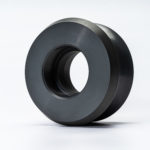
Microscopic damage can become a significant engineering problem when a technical ceramic faces thousands or millions of loading cycles in a corrosive environment. Repeated stress encourages existing flaws to propagate, and chemical species can further weaken vulnerable regions around an advancing crack. Temperature fluctuations may also add thermal stresses that accelerate crack propagation. Known as fatigue corrosion, this interaction can influence the durability of ceramic valves, pump seals, extrusion tooling, and molten-metal components operating under combinations of mechanical, thermal, and chemical strain during service.
Fatigue Corrosion Mechanics in Technical Ceramics
Microscopic flaws provide the primary sites from which fatigue corrosion can develop. Surface damage from machining, grain boundary defects, residual pores, and localised chemical etching concentrate stress around small regions of a ceramic component. Repeated mechanical loading intensifies stress at those locations, allowing microcracks to extend incrementally. Failure can thus occur below the nominal tensile strength if subcritical crack growth continues across a sufficiently large number of loading cycles.
Moreover, chemical exposure can hasten that progression by altering conditions at the crack tip. Moisture, hot acids, alkalis, and reactive gases may attack stressed atomic bonds, lowering resistance to further crack extension. A microcrack that would remain stable under static loading can consequently propagate under cyclic stress. Fatigue corrosion becomes particularly significant in pump components, valve trim, extrusion tooling, and processing equipment subjected to repeated pressure or mechanical cycles.
Rapid temperature changes introduce another corrosion mechanism. Thermal expansion and contraction generate cyclic stresses within the ceramic, especially where temperature gradients develop across a component. Concurrent oxidation or chemical degradation can weaken intergranular phases and increase susceptibility to crack propagation. Density, grain aspect ratio, phase distribution, porosity, and intergranular glass chemistry can therefore impact the fatigue threshold and long-term durability of a technical ceramic.
Engineering Ceramics Against Fatigue Corrosion
Advanced technical ceramics resist fatigue corrosion through combinations of chemical stability, strong atomic bonding, controlled density, and engineered microstructures. Non-oxide ceramics such as silicon nitride and silicon carbide contain strong covalent Si-N and Si-C bonds, which provide substantial resistance to chemical degradation across hot, corrosive industrial environments. Oxide ceramics such as alumina and zirconia rely predominantly on ionic bonding, offering a further route to chemical stability under selected processing conditions.
Beyond chemical stability, interlocking grain structures can restrict crack propagation. Elongated grains force advancing cracks along more tortuous paths, increasing the energy needed for continued growth. Crack deflection and grain bridging can dissipate mechanical energy around the crack tip, improving resistance to cyclic loading. Such microstructural mechanisms are extremely valuable where fatigue corrosion combines mechanical stress with thermal cycling or corrosive exposure.
High density provides an additional safeguard against fatigue corrosion. Porosity introduces stress concentrations and pathways through which corrosive species can penetrate a ceramic microstructure. Near-theoretical densities above 99% minimise internal voids, reducing potential nucleation sites for environment-assisted cracking. Material selection should thus consider microstructure alongside bulk mechanical properties, especially for components exposed to long service periods under changing loads.
Advanced Ceramic Grades and Their Fatigue Performance
Material composition and microstructural engineering influence how technical ceramics respond to fatigue corrosion. International Syalons offers several advanced ceramic grades suited to different combinations of cyclic loading, thermal stress, chemical exposure, and wear:
- Syalon 101- Its elongated beta-SiAlON grain structure offers self-reinforcement and promotes crack deflection. A room-temperature fatigue limit of around 700 MPa, combined with thermal shock resistance of ΔT 900°C, helps limit thermal-fatigue cracking during rapid heating, cooling, and repeated mechanical strain.
- Syalon 050- Alpha and beta-SiAlON phases balance hardness with fracture resistance. Hard alpha-phase grains support wear resistance, whereas tougher beta-phase grains impede crack growth, making the material suitable for cyclic impact, thermal shock, and abrasive high-temperature processing conditions.
- Syalon 110- Designed for severe high-temperature environments, this grade can operate at temperatures up to 1,450°C. Its properties enable resistance to thermal shock and repeated temperature cycling in molten-metal processing, meaning it is well suited to components such as heater and riser tubes.
- Silicon carbide (SiC)- Sintered and reaction-bonded SiC combine high thermal conductivity with strong resistance to acids and alkalis. Efficient heat transfer reduces thermal gradients, and chemical stability limits surface degradation in seal faces and nozzles exposed to corrosive fluids, agitation, and dynamic pressure cycles.
- Zirconia- Toughened or stabilised zirconia uses transformation toughening to impede crack propagation. Stress near a crack tip triggers a local phase transformation that generates compressive stresses around the advancing flaw, improving resistance to severe dynamic mechanical shock.
Choosing between these ceramics comes down to the conditions a component will encounter in service, since different combinations of temperature, chemical exposure, wear, and cyclic stress call for different material properties.
Managing Fatigue Corrosion Through Advanced Ceramics
Combating fatigue corrosion requires careful alignment between ceramic chemistry, grain structure, phase distribution, density, temperature, chemical exposure, and cyclic loading. International Syalons brings more than 40 years of technical ceramics expertise to applications involving severe thermal, chemical, and mechanical conditions, supplying Sialon and silicon nitride compositions alongside specialised SiC, alumina, and zirconia products. For engineers seeking longer component life in corrosive, high-temperature, or mechanically demanding processes, reach out to International Syalons to discuss advanced ceramic solutions for reliable industrial service.