There is no single property that tells an engineer how well a material will resist erosion. Hardness is important when abrasive particles cut or slide across a surface, but other properties become just as vital if those particles strike at high velocity, temperatures fluctuate, or corrosive media enter the process. Different damage mechanisms expose distinct material weaknesses. Consequently, erosion resistance is better assessed across several performance characteristics, with fracture toughness, thermal shock resistance, chemical stability, microstructural quality, and surface finish all contributing useful information.
Fracture toughness versus mechanical hardness
Hardness indicates how effectively a material resists indentation, scratching, and abrasive penetration. High Vickers hardness can therefore reduce material removal when hard particles move across a component surface. Yet erosion introduces impact forces as well as abrasion. Under repeated particle impingement, an exceptionally hard ceramic with insufficient fracture toughness can develop micro-cracks or small surface chips that expose fresh material to further attack.
Fracture toughness provides a crucial counterbalance because it measures resistance to crack propagation. Greater toughness allows erosion-resistant materials to tolerate more impact energy before small flaws extend through the surrounding structure. The relationship between hardness and toughness is particularly relevant in sandblasting nozzles, shot-blasting components, abrasive powder handling equipment, and other systems where particles repeatedly strike ceramic surfaces at high velocity.
Sialon and silicon nitride ceramics offer a strong combination of hardness and fracture toughness. Syalon 101 is engineered to resist abrasive wear as well as mechanical impact, helping limit the micro-chipping that can shorten component life in severe erosion environments. Zirconia ceramics, specifically yttria-stabilised tetragonal zirconia polycrystal (Y-TZP), provide high fracture toughness, impact strength, and excellent surface finish capabilities. Such properties make zirconia valuable for high-stress mechanical components subjected to abrasive contact, repeated loading, and localised impact.
Thermal shock resistance and high-temperature integrity
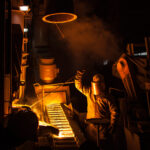
Temperature can intensify erosion if components encounter rapid thermal changes or sustained heat during operation. Molten metal handling equipment, hot process gas systems, burner components, and high-temperature tooling may experience abrasive attack at temperatures where metallic alloys begin to soften or lose mechanical strength. Furthermore, ceramics must withstand thermal stresses generated as individual areas of a component heat or cool at different rates.
Thermal shock resistance reflects how well erosion-resistant materials tolerate sudden temperature changes without cracking. Low coefficients of thermal expansion limit dimensional changes during heating and cooling, reducing the stresses generated inside the component. High thermal conductivity can disperse localised heat more efficiently, helping minimise steep temperature gradients. Fracture toughness and strength are also critical because both influence whether thermally induced flaws continue to propagate.
Sialon ceramics deliver exceptional performance where thermal cycling accompanies erosive wear. Syalon 101 combines strong mechanical properties with excellent thermal shock resistance, supporting molten aluminium handling components and thermocouple protection sheaths exposed to abrupt temperature changes. Meanwhile, Syalon 050 retains high-temperature integrity within severe industrial environments in which heat and abrasion occur concurrently. Silicon carbide provides another useful option for hot abrasive conditions since its high thermal conductivity can dissipate localised frictional heat. At the same time, its exceptional hardness benefits burner nozzles, cyclone liners, and components carrying hot particle-laden gas streams.
Chemical inertness and corrosion-erosion resistance
Chemical attack introduces a different route to accelerated material loss. Acids, alkalis, reactive process chemicals, and molten metals can degrade susceptible phases or grain boundaries within a component. Abrasive particles or flowing media can then remove the chemically weakened surface more easily, exposing new material to continued attack. Corrosion-erosion can thus produce severe damage despite favourable hardness or strength values.
Evaluating chemical stability means considering the process medium as well as concentration, temperature, and exposure duration. Alumina ceramics offer strong chemical inertness in many aggressive environments, making them suitable for chemical processing equipment exposed to corrosive fluids and abrasive media. Their hardness provides additional protection where suspended solids contribute to surface wear.
Sialon and silicon nitride ceramics combine chemical resistance with favourable mechanical and thermal characteristics. Their non-wetting behaviour in molten aluminium and certain other non-ferrous alloys is particularly useful for foundry components like heater tubes, riser tubes, thermocouple protection sheaths, and metal transfer equipment. Reduced wetting limits molten-metal adhesion, erosive washing, and material build-up. For erosion-resistant materials operating in chemically aggressive environments, such behaviour can be just as important as conventional mechanical property values.
Microstructural uniformity and surface micro-finish
Microstructural quality influences how erosion progresses across a ceramic surface. Fine, uniform grain structures reduce weak intergranular pathways that can encourage preferential material removal. Controlled ceramic processing also limits defects capable of acting as initiation points for micro-cracking, helping maintain consistent performance during prolonged exposure to abrasive particles.
Additionally, a ceramic’s surface finish can affect how fluids and abrasive media interact with the component during service. Precision-polished ceramics can reduce friction and surface irregularities that disturb fluid flow or concentrate localised wear. Smooth finishes are extremely useful for high-velocity nozzles, flow-control valves, extrusion dies, and metal-forming tooling, in which surface condition influences friction, flow behaviour, component wear, and dimensional stability.
Ceramic solutions from International Syalons
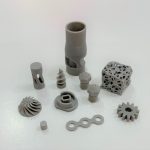
International Syalons supplies erosion-resistant materials for challenging mechanical, thermal, and chemical environments. Our advanced technical ceramic portfolio includes Syalon 101, Syalon 050, silicon nitride, zirconia, alumina, and silicon carbide for molten metal handling, abrasive processing, high-temperature flow systems, and industrial wear components. International Syalons’ technical materials engineers can also assess flow velocity, thermal cycling, chemical exposure, impact, and abrasion when specifying a suitable ceramic. Contact International Syalons to discuss your operating conditions and identify a durable ceramic component that will last under intensive wear and erosion.